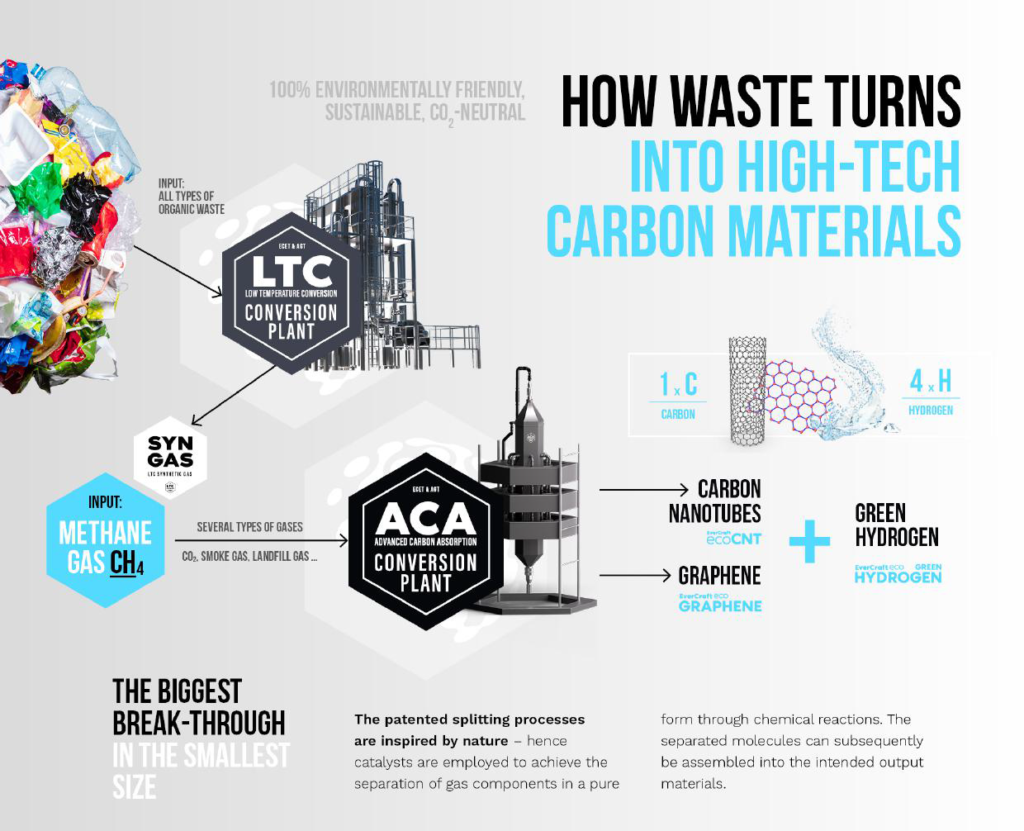
YASAYONI LLC with Tesla-Evercraft CCC technology converts mixed municipal and industrial waste into high-value products including synthetic crude oil, electricity, green hydrogen, and carbon materials—all while producing zero toxic emissions.
Cold Catalytic Conversion (CCC) operates at low temperatures (260-360°C) without pressure, using proprietary catalysts to break down waste molecules efficiently while avoiding harmful emissions.
Shredding, drying, metals/glass removal
CCC reactor transforms waste into SynCrude
Outputs refined into fuels, electricity, H2
| Output Product | Yield | Application |
|---|---|---|
| SynCrude | 0.45–0.55 t / t waste | Refinery feedstock, diesel, gasoline |
| Electricity | 2–4 MWh / t waste | Grid supply, on-site power |
| Green Hydrogen | Optional upgrade | Fuel cells, industrial processes |
| Carbon Materials | By-product | Water treatment, filtration |
| Inert Residue | 5–10% of input | Construction materials |
| Parameter | Incineration | Pyrolysis | Tesla CCC |
|---|---|---|---|
| Temperature | 850–1,100 °C | 400–1,200 °C | 260–360 °C |
| Emissions | Dioxins, NOx | CO, tars | No dioxins / furans |
| Efficiency | 500 kWh/t | 600–900 kWh/t | 2,000–4,000 kWh/t |
| ROI | 7–10 years | 5–8 years | < 3 years |
Ccc process flow
The Tesla–Evercraft system uses Cold Catalytic Conversion (CCC), a low-temperature, zero-pressure technology that transforms mixed municipal and industrial waste into valuable energy products. After pre-treatment—where waste is shredded, dried, and homogenized—the material is fed into the CCC reactor. Inside the reactor, long-chain hydrocarbons break down at 260–360°C using a proprietary catalytic process, producing a clean liquid energy carrier known as SynCrude.
The SynCrude produced by the system is then used as fuel for high-efficiency power generators, producing electricity with no toxic emissions. Part of the SynCrude or recovered hydrogen can be used to produce urea, further increasing the system's economic value.
The remaining solid residue is a non-toxic, non-hazardous carbon ash, which can be safely utilized in the construction industry as filler material, reinforcement additive, asphalt modifier, or other industrial applications supporting true circular material reuse.
The Tesla–Evercraft CCC enables clean, modular waste conversion with multiple valuable outputs: SynCrude, electricity, hydrogen, urea, and reusable carbon ash, while avoiding landfill emissions and creating significant carbon-credit potential.
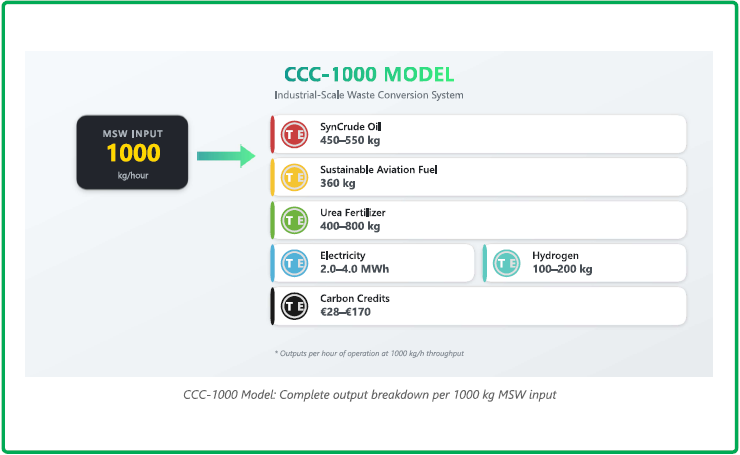
The CCC-1000 delivers industrial-scale processing with maximum energy recovery, perfect for larger cities and industrial symbiosis projects.
3-phase power 400-600V
Water: 2-3 m³/day (closed circuit)
Scalable to 50+ tonnes/day
Multi-module configurations
ROI: <2.5 years
Higher revenue potential
Industrial integration
Large cities (200K+ population)
Industrial symbiosis projects
Refinery co-location
Regional waste facilities
| Feature | CCC-350 | CCC-1000 |
|---|---|---|
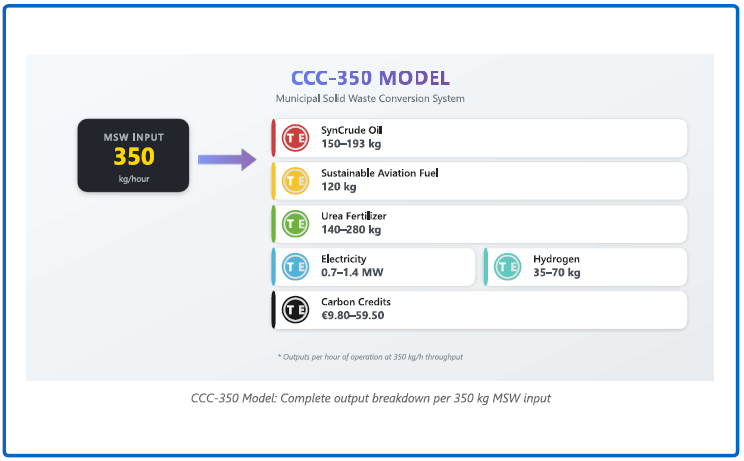
| Capacity | 350 kg/h | 1,000 kg/h |
| Annual Throughput | 3,000–4,000 t | 8,000–8,500 t |
| Daily Processing | 8–10 tonnes | 24 tonnes |
| Population Served | 50K–150K | 200K+ |
| Electricity Output | 16–33.6 MWh / day | 48–96 MWh / day |
| SynCrude Production | 3.6–4.6 t / day | 10.8–13.2 t / day |
| Investment | Contact for quote | Contact for quote |
| Payback Period | < 3 years | < 2.5 years |
| Deployment Time | 6–9 months | 9–12 months |
| Waste Volume | Recommended Model | Configuration |
|---|---|---|
| 5–10 tonnes / day | CCC-350 | Single unit |
| 10–20 tonnes / day | CCC-350 or CCC-1000 | Single unit or 2 × CCC-350 |
| 20–30 tonnes / day | CCC-1000 | Single or dual unit |
| 30–50 tonnes / day | CCC-1000 | 2–3 units |
| 50–100+ tonnes / day | CCC-1000 | 4–10+ units |
Real-World Applications
Configuration: 3× CCC-350 or 1× CCC-1000
City of 200,000 processing 20-30 tonnes/day
Payback: <3 years
Jobs: 15-20
Configuration: 1× CCC-350
Island community with 10 tonnes/day
Payback: <3 years
Jobs: 8-12
Configuration: 5× CCC-1000 (50+ tonnes/day)
Co-located with refinery or cement plant
Payback: <2.5 years
Jobs: 40-60